The Confidence Gradient: Why Agency Owners Trust Last Month but Fear Next Quarter.
Here's the whole thing up front, because I don't like burying the point. At this year's Build a Better Agency Summit, more than 300 agency owners...
7 min read
Craig Cody July 24, 2026
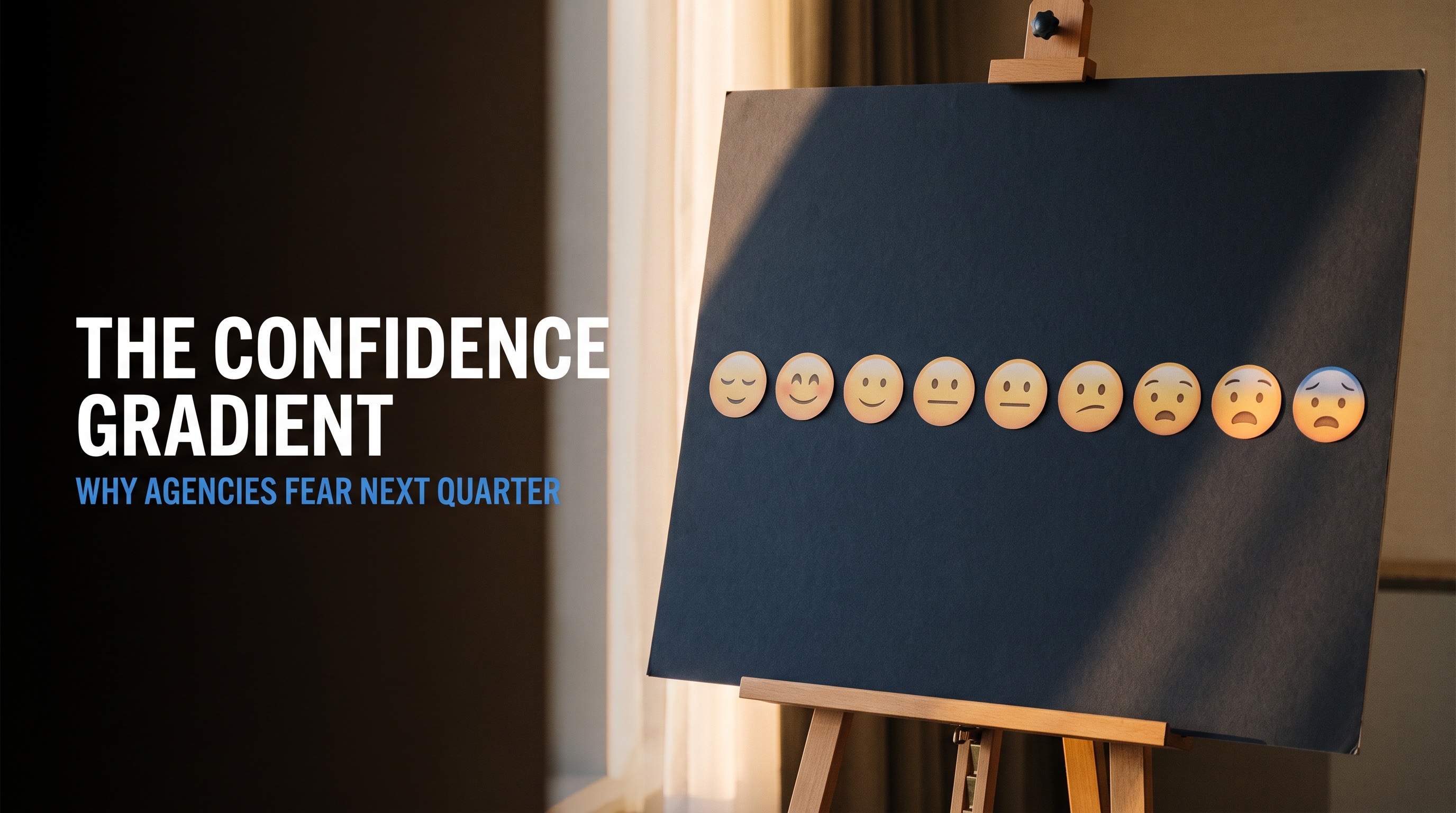
Here's the whole thing up front, because I don't like burying the point. At this year's Build a Better Agency Summit, more than 300 agency owners rated five parts of their financial life with emoji stickers, and the wall showed a clear slope: they feel great about the numbers behind them and increasingly uneasy about the numbers ahead of them. That slope has a name, the confidence gradient, and the gap it exposes, between knowing where you've been and knowing where you're going, is exactly where financial risk builds. In this piece I'll walk all five categories with a fix for each, then add the one forward-looking category that never made the board: your taxes.
I've worked with a good number of agency owners over the years, so when I saw a photo of that board, I didn't blink. I've had this exact conversation across the desk more times than I can count. A gorgeous set of financials, delivered on time every month, and then one question, "what does your next quarter look like," and the room goes quiet.
This comes out of the Agency Management Institute, Drew McLellan's world. At AMI's Build a Better Agency Summit in Denver, someone ran a simple exercise: a board with five categories, a sheet of emoji stickers, and one instruction, rate how you feel about each. No survey, no spreadsheet, just gut reactions from a room full of owners. Drew wrote up the results, and you can read the original here: "What 300 Agency Owners Told Us About Their Financial Confidence, Without Saying a Word."
The diagnosis is theirs, and it's sharp. I read everything through the money lens, so what I'm adding is the part that never made it onto the wall. Let me give you the board first, then the piece they left off.
The confidence gradient is the pattern the stickers formed. On the left sat Financial Reporting, and nearly every sticker was a smile. On the right sat Sales Outlook, and the faces turned worried, with more "poor" ratings than anywhere else on the board. The three categories in between, Forecasting, Profitability, and Cash Management, slid down the slope in order.
The more backward-looking the question, the better owners felt. The more forward-looking the question, the worse they felt. That's the finding in one line: agency owners are confident about where they've been and anxious about where they're going. Now let's walk the slope.
Financial Reporting was the happy end of the board, and good. Most agencies have accurate, on-time financials. The P&L shows up, it's clean, and that's real. It's also table stakes.
The trap is believing that good reporting equals good financial management. It doesn't. Reporting tells you what already happened. It doesn't tell you whether your margins are sustainable, or what a slow quarter does to your cash three months from now. If your reporting is solid, you've built the foundation. The only question that matters is whether you're building anything on top of it.
Forecasting produced the widest spread on the whole board, roughly equal numbers of good, fair, and poor. Some owners clearly trust their forecast. Plenty are flying on gut.
I understand why it's hard. You're project-based. Revenue is lumpy, scopes shift, and one client pushing a launch to next quarter can swing you from profitable to flat. But here's the part worth tattooing somewhere: the agencies that forecast well aren't the ones with the fanciest model. The difference isn't sophistication, it's consistency. A simple process you actually maintain, connect the sales pipeline to expected revenue, track utilization, model the cash impact, will beat a beautiful model you built once and abandoned. Every time. Start simple, keep it current, and you're already ahead of most of the room.
Profitability didn't draw angry reactions. It drew uncertain ones. Owners can sense their margins aren't where they should be, and they can't quite see why. I know this one cold: the agency is growing, busy, landing new clients, and somehow the profit won't move.
It almost always traces back to a lack of visibility, usually one of four leaks:
Profitability isn't one number at the bottom of the P&L. It's margin by service line, by client, by team. Once you can see it at that level, you can finally make a decision about it. Until then, you're guessing.
Cash Management landed in the middle of the board. Not a crisis, but not confidence either. Most agencies manage cash adequately in the short term, and reactively, with no real plan behind it.
The danger is that reactive cash management works right up until it doesn't. One late payment, one surprise expense, one slow new-business month, and the pressure shows up fast, especially in an agency that distributes most of its profit and keeps thin reserves. This is where I say the thing I say to every owner who'll sit still long enough to hear it: profit and cash are not the same thing. A beautiful P&L can still bankrupt you, because the P&L says you earned it and the bank account says it hasn't landed yet.
The fix isn't complicated. Set a defined cash reserve target, a common one is roughly 10% of annual revenue, and build a rolling cash flow forecast that shows how money actually moves through the business week to week. That's the discipline that turns cash from a source of anxiety into a source of control. It's the heart of knowing your numbers.
Sales Outlook was the striking one, the far end of the slope. The most negative reactions on the board, and the most emotional: worried faces, anxious faces, the place where confidence ran out.
Owners are uneasy about what's ahead, whether it's pipeline visibility, client retention, pricing pressure, or the broader market. And this category matters more than the other four, because its uncertainty cascades into everything else. If you don't know what revenue looks like in 90 days, you can't forecast, you can't hire with confidence, and you can't plan cash with any precision. The fix is to connect the sales pipeline directly into the financial forecast, translating opportunities and their probabilities into projected revenue and cash. When sales visibility improves, confidence across every other category tends to climb back up the slope with it.
Here's the line from the original piece that stuck with me: reporting tells you where you've been, advisory tells you where you're going. That's the whole point of the exercise, and I agree with it completely. So let me add the category they didn't put on the wall, because it's the most backward-versus-forward one of all.
Taxes.
Think about how most agency owners handle tax. You get to March, someone adds up what already happened last year, and hands you a bill. That feels handled, so it would earn a smile-face sticker. But it's pure rearview mirror. By the time you see the number, every decision that could have changed it is already behind you. It's the same trap as the reporting category, dressed in different clothes: filing a return feels like financial management, but it's really just documentation of what already happened.
This is the difference between a tax preparer and a tax advisor. A preparer records last year and files the form; that's the rearview mirror, and you learn what you owe after it's too late to change it. A tax advisor looks through the windshield: before the year closes, you decide how the entity's structured, when income lands, and which strategies you're legally entitled to use, so more of the margin you fought for all year actually stays yours. Proactive tax planning is forward-looking by definition. It's the one place where trading the rearview mirror for the windshield can put five or six figures back in your pocket that you'd otherwise hand over for no reason at all.
So look at the whole board again. Every category on it was really asking the same question: are you looking backward or forward? Reporting, backward, and comfortable. Forecasting, profitability, cash, and sales, forward, and that's where the fear lives. Tax is that same question, and it's the one most owners never think to put on the wall.
If you've ever had a great month on paper and still felt your stomach drop when you opened the bank balance, this is for you. That gap, between "we're crushing it" and "so why does it always feel tight," is the whole reason I do this work. It scales down to a founder plus a contractor and up to a full floor of humans; size isn't the point. The payoff isn't only a bigger number at the bottom of the P&L. It's getting to make a hire, or take a week off, without running the math three times first.
If you're looking for someone to file a return in April and never talk to you again, honestly, I'm not your guy. The whole point here is the year-round conversation, the one that happens before the numbers are locked in and there's still something you can do about them. The agencies that flourish are the ones that run the business behind the work on purpose, by the numbers.
What is the confidence gradient for agency owners?
The confidence gradient is the pattern that agency owners feel most confident about backward-looking finances like reporting, and progressively less confident as the questions turn forward, through forecasting, profitability, and cash, down to sales outlook, where confidence is lowest. It surfaced at the 2026 Build a Better Agency Summit when more than 300 owners rated five financial categories with emoji stickers.
How much cash reserve should a marketing agency keep?
A common target is roughly 10% of annual revenue, held as a defined reserve you don't dip below, paired with a rolling cash flow forecast. Together they turn cash from a reactive scramble into something you actually control.
Why isn't my agency more profitable even though we're busy?
Busy but not profitable usually traces to four things: service mix erosion (taking lower-margin work to fill capacity), scope creep (delivering more than you priced), utilization gaps (capacity that isn't billable), and no project-level profitability data, so you know the firm is profitable overall but not which clients, services, or teams are carrying it.
How do I make agency revenue more predictable?
Connect your sales pipeline directly into your financial forecast, translating opportunities and their probabilities into projected revenue and cash. When sales visibility improves, confidence across forecasting, cash, and hiring tends to follow.
What's the difference between a tax preparer and a tax advisor?
A preparer records what already happened and files the return, the rearview mirror, so you learn what you owe after it's too late to change it. A tax advisor plans forward before the year closes, entity structure, income timing, and strategies you're legally entitled to use, so you keep more of what you make.
Craig S. Cody is a CPA, Certified Tax Coach, and former NYPD Lieutenant who helps agency owners keep more of what they make through proactive, year-round tax planning. His firm works with a large number of Agency Management Institute members. The emoji-board exercise cited here took place at the Agency Management Institute's Build a Better Agency Summit and was written up by Drew McLellan; it was an informal gut-check, not a scientific survey. Read the original: agencymanagementinstitute.com/24562-2/.
Here's the whole thing up front, because I don't like burying the point. At this year's Build a Better Agency Summit, more than 300 agency owners...
Two headlines crossed my desk the same week. One was about a private equity deal. One was about AI. And they're both really asking your agency the...
You raised your rates this year, or you're about to. Good. But if you think higher prices fix a leaky agency, I've got some bad news from the P&L....