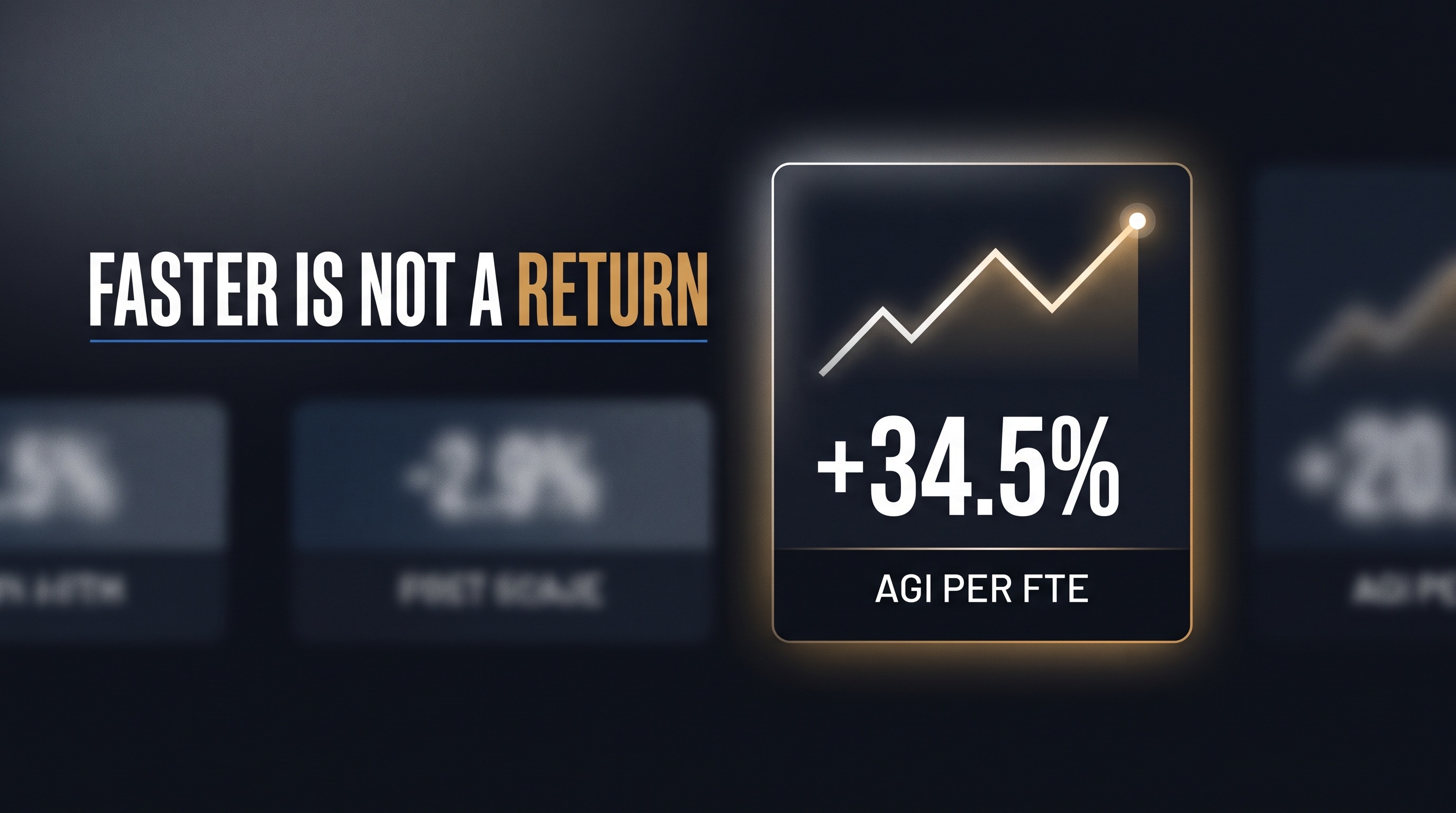
Your Agency's AI ROI Isn't Faster Work. It's Higher AGI Per Employee.
By Craig S. Cody, CPA, Certified Tax Coach. Published July 24, 2026.

8 min read
Craig Cody Updated on July 27, 2026
By Craig S. Cody, CPA, Certified Tax Coach. Published July 24, 2026.
Here's the answer up front, because I don't like burying it. The return on your agency's AI isn't whether the work got faster. It's whether AI raised your AGI per full-time employee, widened your margin, sped up delivery, or made your clients' outcomes better. "The team is getting more done" is a nice feeling, not a return. Saving five hours only counts if those five hours turned into money or a better result for the client. If they just became a slower afternoon, you didn't earn anything. You bought a subscription. Below I'll give you the five numbers that tell you the truth, and the one that matters most.
I've worked with a lot of agency owners over the years, so I've heard the same sentence a dozen times this year: "We're using AI, the team is faster." Good. I mean that. But then I ask the follow-up, "so what did that speed become," and the room goes quiet. That quiet is the whole problem, and it's fixable.
AI makes the work go faster. Everybody feels more productive, so everybody assumes faster automatically means more profitable. It doesn't, and the gap between those two ideas is where the money leaks out.
Think about what actually happened when AI saved your team five hours last week. Where did those hours go? If nobody can answer that, the hours didn't turn into anything. AI creates value only when the saved capacity becomes one of four things: more revenue, higher margin, faster delivery, or a better client outcome. If it didn't become one of those, there's no return to book. There's just a quieter afternoon and a monthly bill.
This is the same trap I see with a beautiful P&L that still can't make payroll. It looks fine on the surface, and the leak is one layer down, in the number nobody named.
Your AI scoreboard shouldn't start with how many tools you bought or how many prompts your team ran. Those are activity, not results. It should start with one number I've been beating the drum on for years: AGI per full-time employee.
AGI is your agency's adjusted gross income, roughly what you keep after the outside cost of delivering the work, and AGI per FTE is that number divided by your full-time people. It's the cleanest read on leverage you've got, because it answers one question: is each human on your team supporting more gross income than they used to?
Here's why that belongs in an AI conversation. Drew McLellan at the Agency Management Institute tracks this across a lot of agencies, and the target he sets is $175,000 of AGI per full-time employee. The agencies pulling ahead aren't stopping there. They're pushing north of $200,000, and some are at $225,000 or $250,000. When you ask how, the answer is always the same three things: they specialized, they systemized, and they use AI deliberately. Deliberately, meaning the saved capacity got pointed at something that shows up in that number. If AI isn't moving your AGI per FTE, you don't have an AI strategy, you have an AI expense.
It can, but adoption and return are two different things, and most agencies are measuring the wrong one.
You've probably heard that about 61% of agencies now use generative AI, against roughly 17% of in-house client teams. Everybody quotes that 61 like it's a scoreboard. It isn't. It's an adoption number. All it says is that six in ten agencies bought the tools and turned them on. It says nothing about whether a single one of them made a dollar doing it. We're all busy measuring how many of us use AI, and almost nobody is measuring what it returned.
So you get a room full of agencies adopting hard and flying blind. They can tell you which tools they use. They can't tell you if their margin moved an inch. Being in the 61% isn't the win. Knowing what AI did to your bottom line is the win, and that takes a scoreboard.
Here are the five. Write them down, because this is the whole point.
Notice what's not on the list: number of tools, number of prompts, how fast a draft came out. None of it made the cut, because none of it is a result. For the gross profit side of this, and why what you keep beats what you bill, that's a rule I come back to constantly.
Three things show up over and over, and none of them is "bought more tools."
First, they can say the return out loud in one sentence. Not "we were faster this quarter," but, to borrow a real example from Drew's work with agencies, "for $75,000, we delivered half a million dollars in revenue." That sentence is capacity converted to revenue in the flesh. The saved time didn't vanish into a longer lunch, it showed up as a client outcome big enough to put a number on. How you price to capture that is its own conversation, and I wrote about pricing your agency's work around outcomes instead of hours separately. Here I only care about one thing: can you see the return clearly enough to say it in a sentence? Most agencies can't, and that's the tell.
Second, they specialize. Specialized, niched agencies are reporting margins 10 to 20 points higher than their generalist peers. That's not gravy. That's the money you reinvest, the money you use to train your team, the money that ends up in your pocket.
Third, look at where it lands for the owner. The average agency owner in the U.S. took home a little north of $250,000 last year. The owners who run on these numbers, the AMI group Drew tracks, took home closer to half a million. Same industry, same tools available to everyone. The difference isn't who has AI. It's who's measuring whether AI made the agency more profitable. Agency profitability has climbed from about 12% a couple years ago to 18% last year, and the disciplined shops are hitting 20% and up. AI is part of that story only for the agencies pointing it at a number.
Fair question. Here's the honest answer.
Most accountants look in the rearview mirror. They tell you what happened last year. They'll never catch this, because "we gave our AI gains away in scope creep and rework" doesn't show up as a line on a tax return. It's invisible to a historian. The Journal of Accountancy has been covering the pressure finance leaders are under to prove a return on this technology, and the real risk, which is moving fast without ever measuring the economics. That's exactly the trap. Everybody's moving fast. Almost nobody's measuring.
When you work with a lot of agencies over a lot of years, and I've been doing this more than 23, you learn where the money actually hides. Right now it's hiding in the gap between "we're faster" and "we're more profitable." Those are two different sentences, and a lot of agencies are about to confuse them. Don't ask whether AI made your team faster. It probably did. Ask whether it made your agency more profitable. That's a numbers question, and the numbers don't lie. It's the heart of running the business by the numbers.
If you've rolled out AI across your team, felt the speed, and quietly wondered whether any of it reached your bottom line, this is for you. That gap, between "we're clearly faster" and "so why does the margin look the same," is exactly the thing worth measuring. It scales down to a founder plus a couple of contractors and up to a full floor of humans. Size isn't the point. The payoff is being able to look at one number and know whether the tools earned their keep.
If you're looking for someone to tell you AI is magic and you should buy three more tools, I'm not your guy. And if "we feel more productive" is a good enough answer for you, you don't need this article. The agencies that flourish are the ones that treat AI like any other investment: they measure what it returned, keep what works, and cut what doesn't.
How do you measure ROI on AI in an agency?
Measure the outcome, not the activity. Start with AGI per full-time employee (is each person supporting more gross income than before), then track realization, cycle time from kickoff to approval, error and rework rate, and how much saved capacity actually converted into revenue. Tool counts and prompt counts are activity, not return, so they don't belong on the scoreboard.
What is AGI per FTE for an agency, and what's a good benchmark?
AGI per FTE is your agency's adjusted gross income (roughly what you keep after the outside cost of delivering the work) divided by your full-time employees. A widely used benchmark from the Agency Management Institute is $175,000 per FTE, with stronger agencies pushing past $200,000 and some reaching $225,000 to $250,000 by specializing, systemizing, and using AI deliberately.
Does AI actually improve agency margins?
It can, but adoption doesn't guarantee it. Roughly 61% of agencies now use generative AI, yet that's an adoption number, not a return. AI improves margin only when the saved capacity becomes more revenue, higher margin, faster delivery, or a better client outcome, and only agencies that measure those results can tell whether it happened.
Why isn't AI making my agency more profitable even though we're faster?
Usually because the saved time leaked instead of converting. Common causes: scope creep that drops realization (faster work you never billed), longer review and rework that eats the cycle-time savings, a stack of subscriptions nobody totals, and capacity that turned into downtime rather than new client work or a higher-value service.
Should agencies use AI to lower their prices?
No. Clients aren't asking you to get cheaper because you use AI, they want smarter, deeper work. Using AI to cut prices is a race to the bottom; using it to do better work you can charge for keeps the margin with you. How to price around outcomes is a separate topic worth its own read.
Want a second set of eyes on whether AI is actually helping your margin or just your mood? Pull your AGI per full-time employee for this year and last, and if the number's flat while your tool spend climbed, that's your starting line. A free tax and profit analysis is where we look at the real numbers together and I show you where the return is, and where it's leaking. Let's talk.
Craig S. Cody is a CPA, Certified Tax Coach, and former NYPD Lieutenant who helps agency owners keep more of what they make through proactive, year-round tax planning and fractional CFO work. His firm works with a large number of Agency Management Institute members. The AGI-per-FTE benchmarks, adoption figures, and profitability data cited here come from Drew McLellan's 2026 agency trends report on the Build a Better Agency podcast (Episode 560); the financial interpretation is my own.
By Craig S. Cody, CPA, Certified Tax Coach. Published July 24, 2026.
Here's the whole thing up front, because I don't like burying the point. At this year's Build a Better Agency Summit, more than 300 agency owners...
Two headlines crossed my desk the same week. One was about a private equity deal. One was about AI. And they're both really asking your agency the...