
7 min read

You Hired a Leader and Everything Got Harder. Here's What It's Costing You!

You Hired a Leader and Everything Got Harder. Here's What It's Costing You!
11:17

You finally hired the Head of Delivery, or promoted someone into a COO seat. You expected relief. Instead you got more questions, more "can you weigh in," more awkward overlap between people who all mean well. It feels like a people problem.

Here's the short answer, up front: it's usually not a people problem. It's a design problem, and it's costing you real money in two places at once. First, the confusion, rework, and constant escalations are a hidden tax on your margin that never shows up on your P&L. Second, and this is the expensive one, if you're the human resolving every ambiguity, your agency still can't run without you, which caps what it's worth. The fix isn't hoping goodwill sorts it out. It's designing the integration on purpose. Let me show you what that looks like, and why I care about it as your CPA.

First, Credit Where It's Due

The playbook I'm building on comes from Karl Sakas, who advises agency owners over at sakasandcompany.com. He wrote a sharp piece, how to integrate a new agency leader without creating a "leadership vacuum," and he lays out a practical 30, 60, 90 day plan to do it. The framework is his. I read it the way I read everything, through the money lens, so the financial reframe is mine.

Karl's core point is one I've watched play out in agency after agency: you didn't just hire a leader, you changed your operating system, and you have to actually integrate them into it. Roles, decision rights, handoffs, communication norms. Skip that and good people collide.

Why One More Leader Makes Everything Feel Harder

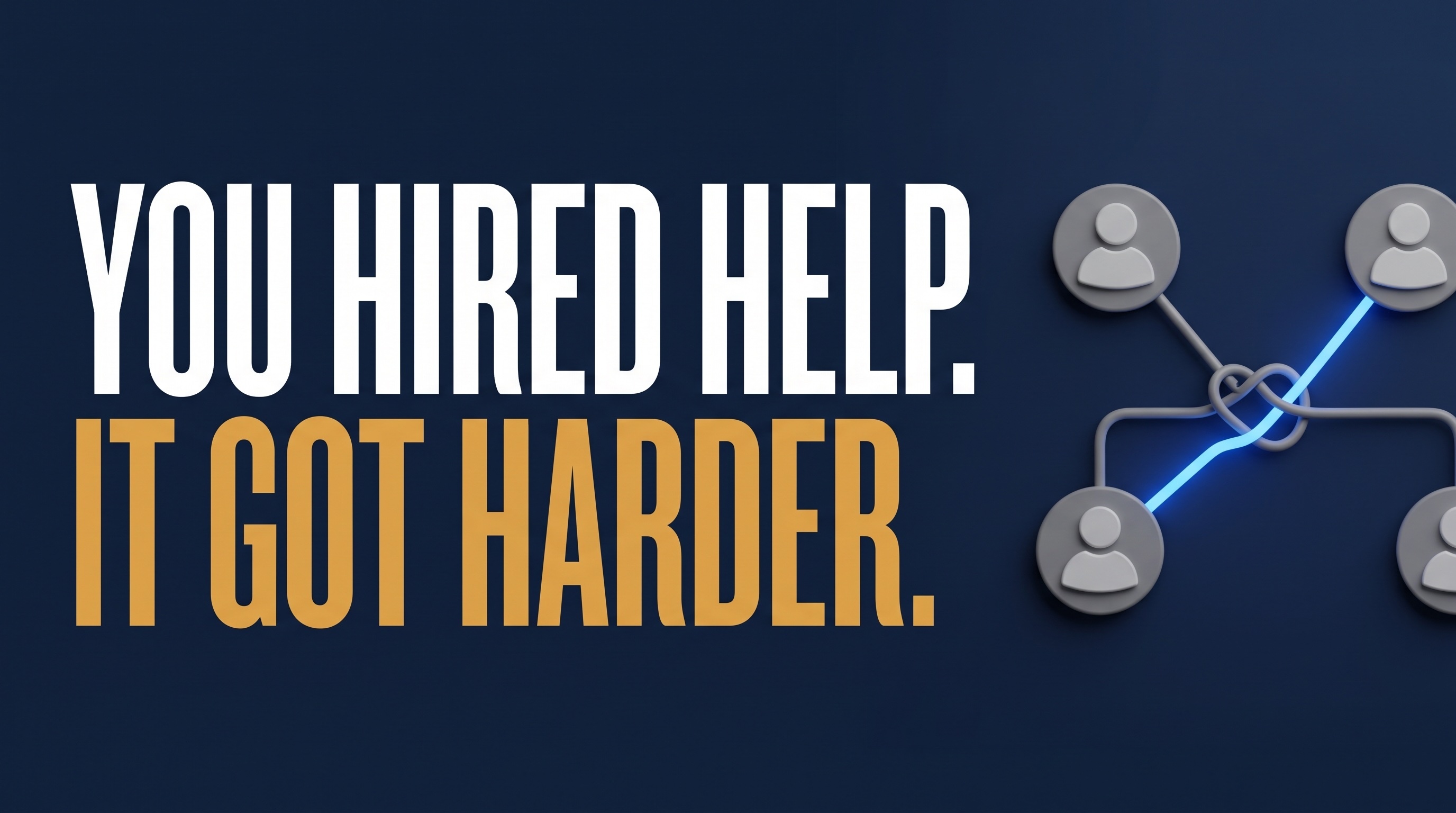
When you go from two leaders to three, you don't add 50% more complexity. You add a whole web of new communication paths, and every one is a chance for a misread, an overlap, or a turf question nobody saw coming.

Karl names two failure modes that show up fast, and I want you to see the dollar sign hanging off each one.

The first is the leadership vacuum. Nobody defined who owns what, so your leaders step in wherever they see a need. They help, they react, they fill gaps. And they collide, because nobody designed the boundaries.

The second is shadow leadership. The old leader, or you, keeps doing the work "for now," because the new person is still ramping and the stakes feel high. It's understandable. It's also how you train a new leader to disengage or quit, after you paid to recruit them.

Both of these feel like personality friction. They're not. They're the predictable output of a system nobody drew on purpose.

The Confusion Tax: What This Quietly Costs Your Margin

Here's where I come in. If you've followed my work, you know the number I care about isn't revenue. It's your Agency Gross Profit, what you actually keep after the cost of delivering the work. And the benchmark I drum on is the 55/25/20 model: roughly 55% to people, 25% to overhead, 20% to profit.

Now look at a messy leader integration through that lens. The duplicated effort. The meeting that grew from three people to seven because nobody was sure who needed to be there. The rework when two leaders gave the client different answers. The hours your senior humans burn escalating things to you instead of deciding.

That's a cost. A real one. I call it the confusion tax. And here's the trap: it lands entirely inside your people-cost line, on your most expensive humans, and it shows up nowhere as a line item. Your P&L just says payroll went up and margin got thinner. It never says why.

This is the part most accountants miss, because most accountants look in the rearview mirror. They tell you what happened last quarter. They'll never catch a confusion tax, because "we wasted 200 senior hours on turf ambiguity" doesn't have its own row on a tax return. It's invisible to a historian. When you've been inside agency books for as long as I have, you learn to look through the windshield instead, and you start to see exactly where that money hides.

Days 0 to 30: Stabilize and Clarify

Karl's plan starts with a month of stabilization, not transformation. A few moves matter most, and each one plugs a specific leak.

Run a role handshake meeting with the owner, the incumbent leader, and the new leader in the room. Agree out loud on what the new leader owns now, what the incumbent owns, what you still own, and what's a gray area. The output is a one-page living document. Skip this and you haven't been "flexible," you've built the vacuum.

Build a light decision-rights matrix on only your highest-friction workflows first, things like client escalations, capacity planning, and who talks to a client when an account runs out of hours. Don't try to map everything. Add edge cases as they show up.

Install a "no vague handoffs" rule. New leaders don't know your unwritten rules yet, so make the handoff explicit: what decision is needed, by when, who owns the follow-up, and the default next step if nobody responds. That's not bureaucracy, it's the difference between a clean pass and a dropped ball you pay for later.

Days 31 to 60: Transfer Authority, Not Just Tasks

Month two is where most integrations quietly fail, because the new leader is doing work but not building authority. You can hand someone every task on the list and still keep all the power, and if you do, you've bought yourself an expensive assistant, not a leader.

Two of Karl's moves do the heavy lifting here.

Protect the new leader's meetings. A meeting invite is a power signal. If the new leader owns a process, don't add the incumbent to the invite as "optional." A veteran with history and strong opinions rarely stays quiet in the room, and pretty soon they're steering the plan. Usually it isn't a power play, it's just habit, but the new leader loses the room either way. Get the incumbent's input beforehand, in a pre-meeting or a quick one-on-one, then let the new leader run the working session.

Have the "incumbent fear" conversation early. When you bring in a delivery leader or a COO, the person whose role just shrank often feels threatened, even if they never say it. That fear turns into vagueness, criticism, or quiet obstruction. Name it directly and kindly: your role is changing, this isn't about replacing you, I need your support and I need your concerns to be specific. Losing a promising new leader to an unspoken turf war is one of the most expensive outcomes an owner can trigger, and it's entirely preventable.

Days 61 to 90: Harden the System and Get Yourself Out of the Middle

By month three you've seen enough real situations to turn lessons into standing systems: a meeting list with clear owners, a client map, a decision-rights doc that's now grounded in what actually happened.

Then run a 90-day integration debrief. And here's the reframe that matters most, straight from Karl: you're not reviewing the person, you're reviewing the system. Where did ambiguity cost you time? What decisions should never hit your desk again? What has to be true for you, the owner, to be optional in this part of the business?

As Karl puts it, that's the difference between "competent people" and a "competent system." Even great humans lose in a system nobody designed. That line is the whole ballgame.

The Real Prize: An Agency That Runs Without You

Here's why a CPA is writing about your org chart. Everything above protects your margin, and that's good. But the bigger prize is what it does to what your agency is worth.

If your agency depends on you to resolve every ambiguity, you are not optional yet. And an agency that can't run without its owner is a hard thing to sell, because a buyer isn't purchasing your instincts, they're purchasing a business that keeps working after you hand over the keys. A clean leadership structure, with real decision rights and leaders who settle things without routing everything through you, is one of the most direct ways to raise your enterprise value. It's the same idea I keep coming back to in is your agency worth anything without you: the money and the freedom both live on the other side of owner dependence.

Done right, integrating a leader speeds up decisions, shrinks the confusion tax, gets your leaders collaborating directly, and makes the whole agency more resilient. You protect this year's profit and you build next year's sale price at the same time.

Who This Is For, and Who It Isn't

This is for agency owners who just added, or are about to add, a delivery or operations leader, and who want that hire to actually reduce their load instead of adding to it. If you're building toward a business that can run, scale, or sell without you at the center, this is squarely for you.

It's less useful if you're a solo operator with no leadership layer yet, or if you're honestly not ready to give up final say on the day-to-day. And I'll name the uncomfortable truth: this only works if you're willing to let a decision be made differently than you'd have made it. If every "new leader decides" quietly still means "the owner decides," the vacuum comes right back, and so does the tax.

The Takeaways

Let's keep it simple:

  • A rocky leader integration is usually a design problem, not a people problem
  • The confusion, rework, and escalations are a hidden tax on your gross profit that never shows up on your P&L
  • Transfer authority, not just tasks, or you've hired an expensive assistant
  • Review the system, not the person, when things feel rough
  • The real payoff is an agency that runs without you, which is what protects your margin and builds your enterprise value

Let's Talk Before the Next Hire

If you're bringing on a leader in the next few months, the worst time to think about the financial cost of a bad integration is after your margin's already thinned and you're still the referee for everything.

We help agency owners see the confusion tax hiding in their numbers, protect their gross profit, and build a business that's worth more precisely because it doesn't depend on them. If you want a second set of eyes on where your margin and your owner-dependence really stand, let's talk. The conversation is free, and it usually happens long before a problem shows up on a financial statement. You can also see how our fractional CFO work helps owners run by the numbers all year.

Because the goal is always the same. Keep more of what you make, and build something that keeps more of its value without you.


Craig S. Cody is a CPA, Certified Tax Coach, two-time bestselling author, and host of The Progressive Agency Podcast. A retired NYPD Lieutenant, he founded Craig Cody and Company in 2000 and works with marketing agency owners across all 50 states. This article is general business and tax education, not individualized advice. The leader-integration framework is credited to Karl Sakas (sakasandcompany.com); the financial interpretation is the author's own. The 55/25/20 benchmark is a general guideline, not a rule that fits every agency.


You Hired a Leader and Everything Got Harder. Here's What It's Costing You!

You Hired a Leader and Everything Got Harder. Here's What It's Costing You!

You finally hired the Head of Delivery, or promoted someone into a COO seat. You expected relief. Instead you got more questions, more "can you weigh...

Read More
AI Is Not Free Labor. Here's the Bill Hiding in Your Agency's Margin

AI Is Not Free Labor. Here's the Bill Hiding in Your Agency's Margin

Everybody's telling you how much time AI is saving your agency. Almost nobody's asking what it's costing you.

Read More
Can You Write Off a Vacation? How to Turn a Trip Into a Legal Tax Deduction!

Can You Write Off a Vacation? How to Turn a Trip Into a Legal Tax Deduction!

You're booking a trip somewhere good. A flight, a nice hotel, a few days you've earned. And a thought crosses your mind: is any of this deductible?

Read More